

Spring Training Updates: Sticky Whiffs
Do any spring training stats actually matter?

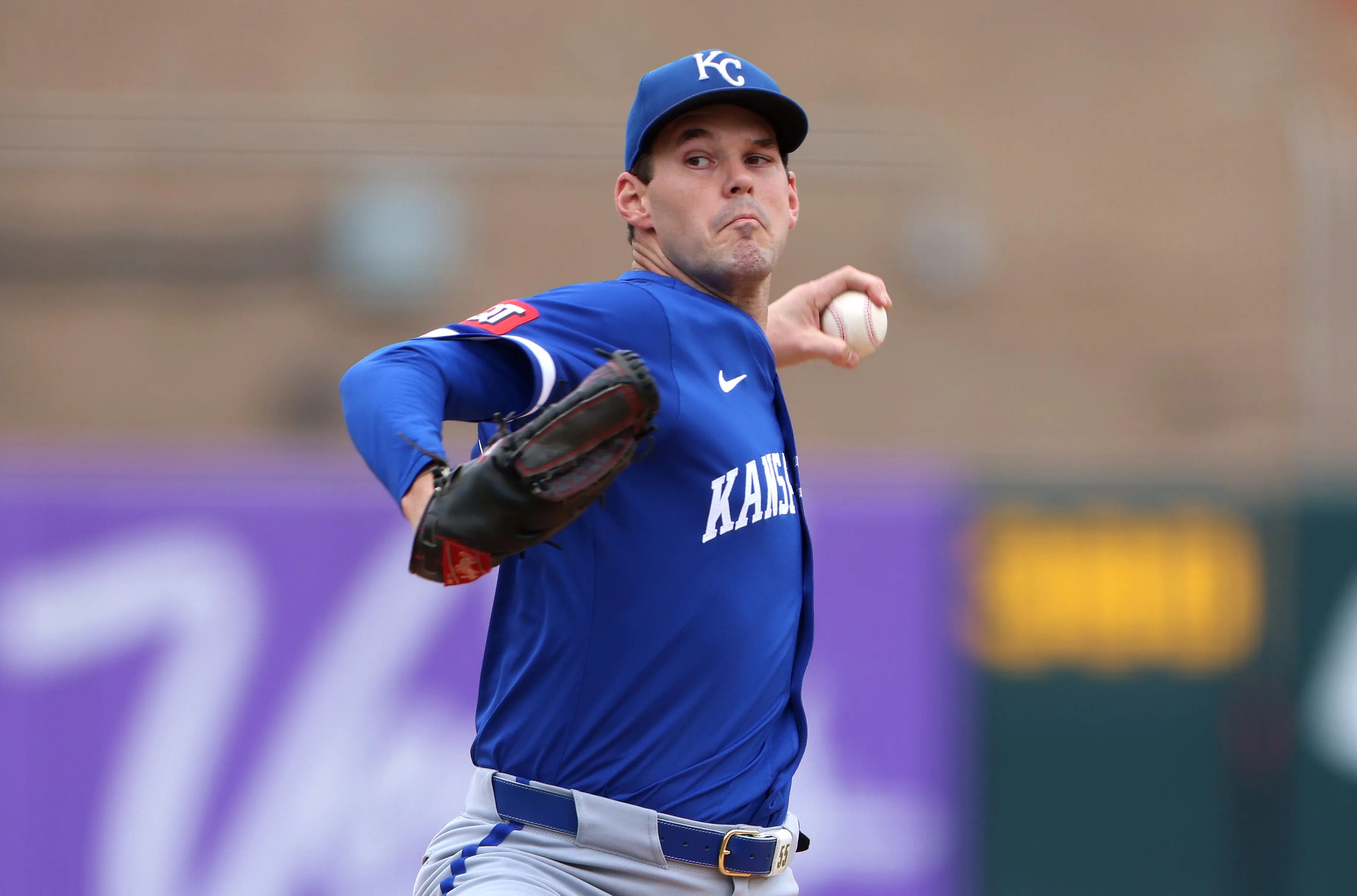
We’re now 14 games into the Kansas City Royals’ spring training slate. The boys in blue are 6-7-1 in Cactus League action, good for 12th in the league to this point. The good news is, wins don’t mean much in Arizona this time of year. To be honest, it seems like all the seasons the Royals fared well in Cactus League play, they went on to fall flat in the regular season. Thus, with the “poor” start so far in Spring Training, I’d say it bodes well for the regular season outlook. Not much is “sticky” in spring training. In recent years, we’ve seen dominant spring training performances from players like Michael Massey and Franmil Reyes. Most of the time, those standout players don’t have the same success by the time April rolls around.
Most of that has to do with sample size; the rest of it has to do with the level of competition. Qualified hitters at this juncture only have 19+ plate appearances. Among them, for the Royals, Josh Rojas leads the way with a 1.332 OPS. He’s slugged .882, which will certainly not be sticky to any degree if he makes the roster at all. So what is “sticky” in spring training? What the hell does that even mean? What I mean by sticky is something that we can see in Spring Training that could also continue into the regular season.
Some things that won’t include Rojas’s slugging percentage, and Michael Massey’s .400 average. Cole Ragans has a 14.73 ERA — not sticky. Usually, strikeouts and walks translate well from spring training to April. Exit velocity, while it’s usually higher in Arizona than we will see anywhere else, translates to some degree. From 2022 to 2024, the top ten in Spring Training Avg EV were as follows:
Ke’Bryan Hayes, 95.7 MPH
Jake Burger, 95.5 MPH
Randy Arozarena, 95.1 MPH
Gabriel Moreno, 94.8 MPH
Kody Clemens, 94.1 MPH
Giancarlo Stanton, 94.1 MPH
Bobby Witt Jr., 94.1 MPH
Kyle Schwarber, 93.9 MPH
Pete Alonso, 93.9 MPH
Aaron Judge, 93.8 MPH
There are some outlier names, but for the most part, that list is about who you’d expect to mash the baseball in the regular season. Another metric that tends to translate well is one that I don’t often see covered closely in the spring: fastball whiff rate. In the modern era of baseball, it’s perhaps one of the most important statistics for a pitcher. Without a strong fastball, pitchers will almost always struggle. Since 2023, pitchers among the leaders for fastball whiff rate in Spring Training include many of the names you’d expect: Luis Gil, Spencer Arrighetti, Paul Skenes, Garrett Crochet, Matt Strahm, Yimi Garcia, Jordan Hicks, and Tarik Skubal. Simply put, if you can’t miss bats with your fastball in spring, you aren’t likely to do it in the regular season.
EightOneSix is a reader-supported publication. To receive new posts and support my work, consider becoming a free or paid subscriber.
Just like anything else, there are limitations to how well it will translate to the regular season. Lucas Erceg, for example, has a 0% Whiff Rate with his heater this spring, but has only thrown five. That’s not exactly a sample worth taking anything from. I ran a Baseball Savant search, asking for the best fastball whiff rate among Royals pitchers this spring with a minimum of 25 fastballs thrown. Here are the results:
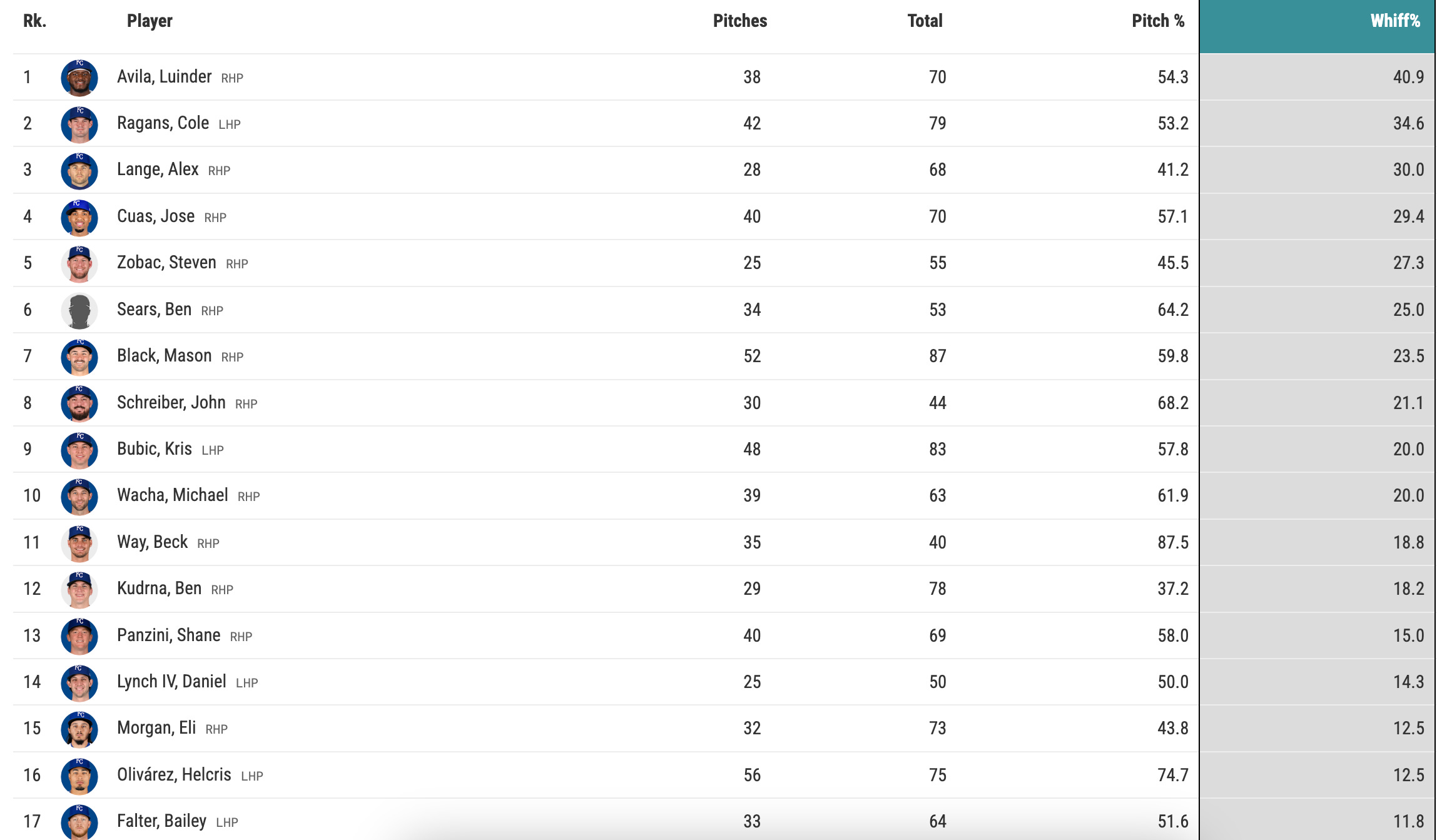
In the 2025 regular season, among pitchers with at least 200 fastballs thrown, Edwin Diaz led the league with a 39.4% Whiff%. The median mark for 2025 was 19.3%, providing a reference point for what might be considered above or below average. With those marks in mind, the Royals have a good mix of pitchers showcasing strong fastballs in Arizona so far. Cole Ragans is no surprise, and although Luinder Avila is no surprise to me, he may be for many fans. The long-time Royals prospect has made impressive developments over the last two seasons. He was throwing low-90s in 2023 and now commands one of the most impressive fastballs in the organization.
Newcomers this offseason — Mason Black, Jose Cuas, and Alex Lange — also stand out on this list. Black and Lange could be important bullpen pieces this season, and Cuas could be important depth in Omaha in case of injury. On the opposite end of the spectrum, roster hopeful Helcris Olivárez has a next-to-zero chance to make the roster at this point. His fastball has looked abysmal thus far, and with limited command, there’s not much there without an effective fastball. Daniel Lynch IV and Bailey Falter are more concerning, as both are expected to factor into the Major League roster in 2026.
For Lynch, the results are relatively flat compared to what he turned in a season ago. In 2025, he finished with a fastball whiff rate of 13.9%. Lynch has long lived on a below-average fastball, but saw a nice bump in strikeout rate in his standout 2024 season. Last year, however, the strikeouts fell back to just 15.6%, and he finished the season with -0.2 fWAR. Based on what remains a poor fastball, I would expect more of the same in 2026.
Bailey Falter is an interesting story. Last season, he had a 15.1% whiff rate with his four-seam fastball before the trade that sent him from Pittsburgh to Kansas City. He averaged 92.1 mph with 18.5 inches of induced vertical break (iVB). All of that stayed relatively the same after moving to Kansas City, as did his extension and spin rate. However, Falter saw an uptick in whiff rate to over 20%. This spring, however, he’s been at the bottom of the barrel for fastball whiff rate. Whatever changed a season ago doesn’t seem to have carried over to 2026. Without any options remaining and some better options on the roster bubble, Falter may find his way onto waivers before we get to Opening Day.
Thanks for reading EightOneSix! This post is public so feel free to share it.
Noah Cameron's worst pitch is his fastball. Does that bode poorly for his future even if his other pitches are good?