
2026 Projections: Part Two
Can Isaac Collins succeed in Kansas City?

When I tell you it’s been dead for Royals news in the last couple of weeks, that feels like an understatement somehow. The opening of the international signing period came and went, with 15 or so different signings hitting the transaction wire for Kansas City. News broke from Ken Rosenthal that the Royals had become “increasingly unlikely” to add either Jarren Duran or Brendan Donovan via trade. Carlos Beltrán was elected to the Baseball Hall of Fame. The one-time Royal won Rookie of the Year in 1999 when he posted the second-best fWAR by a Royals rookie hitter in club history. That mark trailed only Kevin Seitzer (1987) at the time and has since been tied by Mike Aviles (2008).
Some small news broke on Monday when the Royals signed reliever Hector Neris to a minor league contract. He will receive an invite to Major League Spring Training with a chance to make the team. Neris, 36, spent the majority of his long big league career with the Phillies. He made one appearance in 2014 but truly reached the big leagues for good in 2015, posting a 3.79 ERA across 40.1 IP. In all, Neris has been worth 7.2 fWAR in parts of 12 MLB seasons. His most successful season came in 2022 with the MLB Champion Astros (ironically defeating the Phillies in the World Series). Neris struck out 79 batters with just 17 walks en route to a 3.72 ERA and 2.35 FIP. If there’s still any gas left in the tank, Neris could pitch some low-leverage innings and offer some length to the Royals’ bullpen this season.
Earlier this month, I published my first batch of 2026 projections for the Royals. Thank you for your support, thoughts, and questions over there. I always appreciate it! This time around, I have the rest of the hitters projected out for 2026. This group includes the outfielders and depth spots. I projected anyone I expect to have a notable MLB role this season, but left off those who may or may not be on the Major League roster at some point. That means Peyton Wilson, Javi Vaz, and Drew Waters were all left off the list. Kameron Misner, Nick Loftin, and Tyler Tolbert were included.
Here’s where the projections landed:
Isaac Collins: 145 G, .255/.331/.443, 14 HR, 20 SB, 12.2% BB%, 20.6% K%
Carter Jensen: 140 G, .266/.324/.466, 19 HR, 11 SB, 9.9% BB%, 23.9% K%
Kyle Isbel: 125 G, .257/.294/.398, 8 HR, 9 SB, 5.9% BB%, 20.9% K%
Tyler Tolbet: 50 G, .239/.271/.356, 1 HR, 16 SB, 6.3% BB%, 21.3% K%
Lane Thomas: 125 G, .238/.292/.405, 15 HR, 25 SB, 7.7% BB%, 26.7% K%
Nick Loftin: 50 G, .223/.281/.403, 4 HR, 6 SB, 9.3% BB%, 13.2% K%
Abraham Toro: 85 G, .248/.262/.385, 8 HR, 1 SB, 3.5% BB%, 16.1% K%
John Rave: 45 G, .248/.310/.413, 3 HR, 10 SB, 9.6% BB%, 24.2% K%
Kameron Misner: 40 G, .224/.252/.420, 5 HR, 6 SB, 6.2% BB%, 26.9% K%
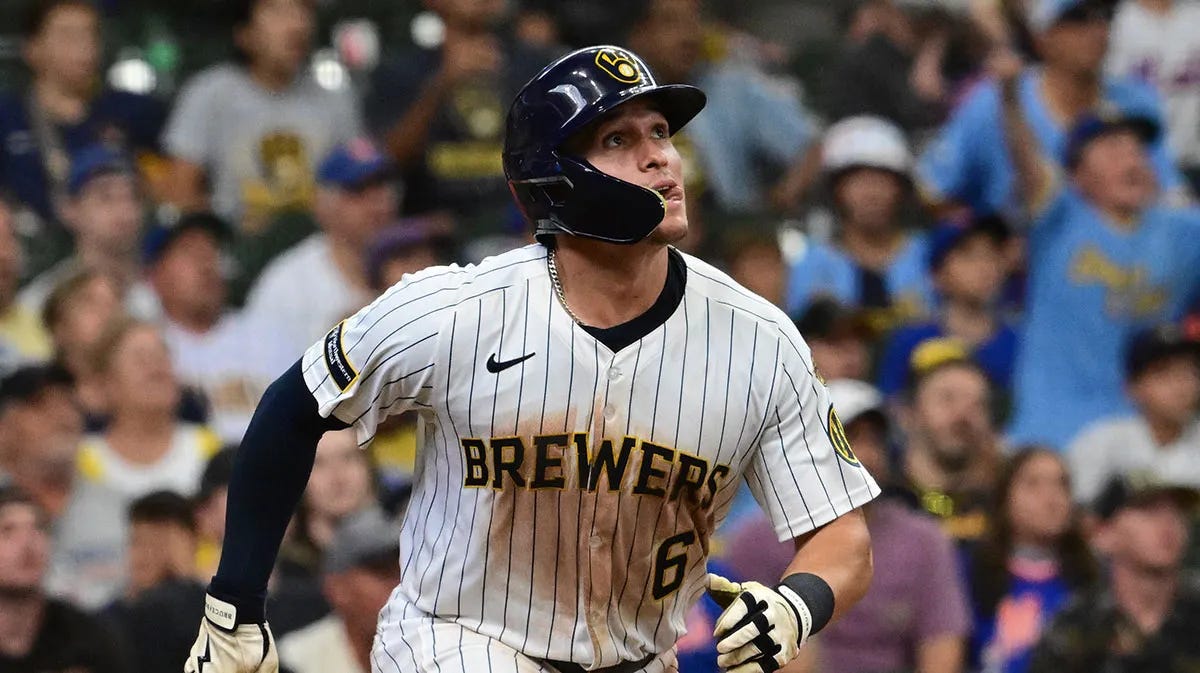
Collins surprised me somewhat, as I expected to see a lower power projection based on some of the underlying data from a year ago. He finished last season with plenty of red flags, including a 14th percentile xSLG and 17th percentile Barrel rate. However, Collins has slightly above-average bat speed and makes a lot of contact. Digging deeper, it felt important to compare the ballpark in Milwaukee to where Collins will play half of his games in 2026. How will the change of scenery impact things? In most cases, Kauffman has historically been seen as a limitation to production. We saw it with Jonathan India leaving Great American Ballpark. This time around, however, I’m not sure we will see the same impact.
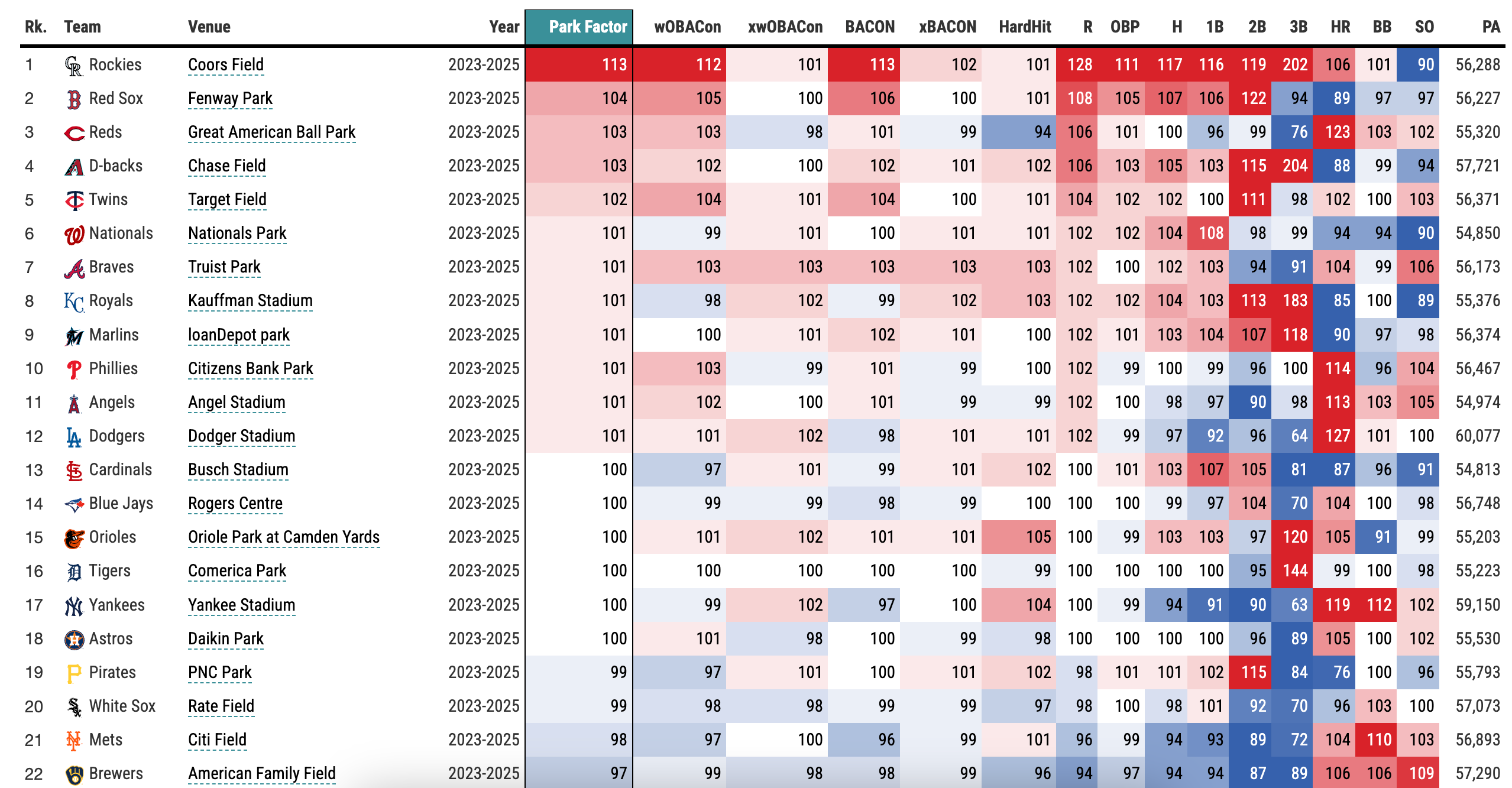
Last season, American Family Field ranked 22nd in Park Factor for hitters at 97. Kauffman Stadium was tied for sixth at 101. Moving in the fences will impact that further, potentially making The K a top 5 hitter-friendly park in 2026. Where The K plays well is where American Family Field doesn’t: Doubles and Triples. While Collins will likely see some drop off in home runs, I don’t expect it to be a heavy drop. He’d have lost 4 last season based on Expected Home Runs by Park, and with the fences moving in, that number would almost certainly be lower. If home runs remain relatively flat, and Collins sees a notable uptick in doubles and triples, he stands to actually be a much better power bat with the Royals. Throughout his minor league career, Collins showcased plenty of speed, and that speed should suit him well in The K, further boosting his production.
Carter Jensen is projected here again. Compared to my previous projection a month ago, Jensen received an additional two home runs thanks to the fences moving in. That pushes his projection up to 19. He’s a clear Rookie of the Year favorite, and if he can pull off this sort of stat line in 2026, he may just come away with the Award outright.
The other outfielders on this list offer a wide range of output. Isbel, Thomas, Rave, and Misner round out the group. Thomas projects to be what he’s been for much of his career: a power bat with low average output and low walk rates. If Thomas could walk at a higher rate (as he did in 2021) or hit for a higher average (as he did in 2023) he would offer more value. However, these projections don’t expect him to do either of those things. He will still be a solid contributor, but should be more of a bench piece rather than a true everyday type of player.
Rave, Isbel, and Misner will combine to fill the center field spot in 2026. Isbel hasn’t been mentioned much, but should benefit nicely from the fences moving in. With this stat line and great defense, the Royals will again be able to push off upgrading center field at least until 2027. Misner is an interesting name. The Royals have had interest since at least 2016 when they drafted him out of Poplar Bluff. The front office acquired him via trade this offseason. He’s 28, bats left-handed, and played strong center field defense for the Rays a year ago. He strikes out far too much, and much of his minor league value came from walks and good power output. He’s an insurance policy (the break-glass type) in case Isbel goes down with injury, rather than a true MLB bench piece.
Rave, Loftin, and Tolbert are all fringe roster pieces that are best left on the Omaha side of things. Tolbert has the best chance to make the roster thanks to his speed and the Royals’ desire to have that pinch runner available for game situations. Abraham Toro belongs in this same tier, although likely lands on the Kansas City side of the fence. He’s never reached his one-time prospect status, but rarely strikes out. His xBA last season was .253, falling right in line with this projection. Toro doesn’t barrel the baseball or hit it hard to any real degree, but should be able to fill the Nick Loftin role a bit better than, well, Nick Loftin.
EightOneSix is a reader-supported publication. To receive new posts and support my work, consider becoming a free or paid subscriber.
Rounding out these hitter projections, it becomes increasingly clear that the Royals need more infield depth. The mix of Nick Loftin, Abraham Toro, and Michael Massey is not a solid bunch. If Jonathan India again struggles, the Royals have no real plan for second base. Relying on this trio or a spark from Javi Vaz or Peyton Wilson is not a strong backup plan. There are options on the free agent market, many of which won’t cost a ton. The Royals desperately need to consider one more move to wrap up the offseason rather than rely again on Loftin, Massey, and a mixture of non-roster invitees to step up and fill the bench.
Honestly, I'd take most of those numbers from those guys. A high 600s OPS is so much better than what we got from our outfielders and bench last year that it almost makes me giddy